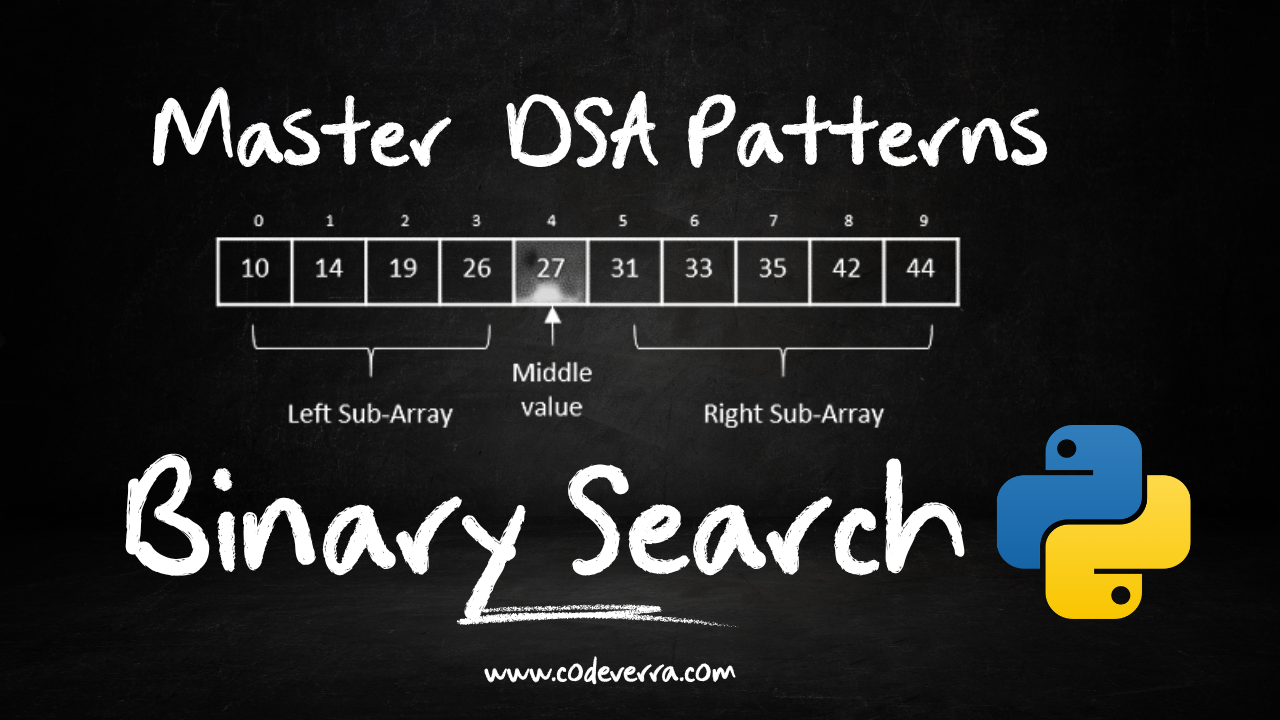
🔰 Pattern 2: Binary Search
Table of Contents
- What is Binary Search?
- The Core Idea - Why Halving Works
- The Three Binary Search Templates
- Binary Search on Answer - The Hidden Pattern
- Common Pitfalls
- Problem Set
- Problem 1: Binary Search
- Problem 2: Search Insert Position
- Problem 3: Find First and Last Position of Element in Sorted Array
- Problem 4: Search a 2D Matrix
- Problem 5: Search in Rotated Sorted Array
- Problem 6: Find Minimum in Rotated Sorted Array
- Problem 7: Koko Eating Bananas
- Problem 8: Capacity to Ship Packages Within D Days
- Problem 9: Split Array Largest Sum
- Problem 10: Median of Two Sorted Arrays
- Key Takeaways & Summary
What is Binary Search?
In the Two Pointers pattern, we used two indices to narrow down a search space. Binary search takes that idea to its most powerful form: instead of narrowing one step at a time, we cut the search space in half at every step.
Let’s see the difference with a concrete example.
Problem: Find the number 7 in a sorted array of 1 million elements.
Linear search (one by one): Check index 0, then 1, then 2… up to 1,000,000 in the worst case.
Binary search (halving):
Step 1:  Check middle of 1,000,000 elements → eliminate 500,000
Step 2:  Check middle of 500,000 elements   → eliminate 250,000
Step 3:  Check middle of 250,000 elements   → eliminate 125,000
...
Step 20: Check middle of 1 element          → found (or not)
20 steps to search 1 million elements. That’s the power of halving - each step eliminates half the remaining possibilities.
Binary Search is a technique where you repeatedly divide the search space in half, using a condition to decide which half to keep, until you find your target or narrow down to a single candidate.
Connection to Two Pointers
Binary search uses two pointers (low and high) that converge, just like opposite-direction two pointers. The difference:
| Two Pointers | Binary Search | |
|---|---|---|
| Movement | One step at a time | Jump to the middle |
| Elimination | One element per step | Half the space per step |
| Time | O(n) | O(log n) |
| Requirement | Usually sorted | Must have a condition that splits the space |
The Core Idea - Why Halving Works
Binary search works whenever you have a monotonic condition - a property that is False for one portion of the search space and True for the rest (or vice versa), with a clean boundary between them.
Index:     0   1   2   3   4   5   6   7   8   9
Condition: F   F   F   F   T   T   T   T   T   T
                         ^
                    boundary (first True)
At any point, if we check the middle and find:
- True → the boundary is at or to the left → search left half
- False → the boundary is to the right → search right half
Each check eliminates half the candidates. After log₂(n) checks, we’ve found the boundary.
This is more general than “finding a number in a sorted array.” The sorted-array case is just one instance where the condition is arr[mid] >= target. Binary search applies anytime you can define such a condition:
- “Is this speed fast enough to finish the task?” (Binary Search on Answer)
- “Is this capacity sufficient to ship all packages?” (Binary Search on Answer)
- “Is
arr[mid]in the left or right half of a rotated array?” (Rotated Array Search)
The Three Binary Search Templates
Different problems need slightly different templates. The variations come down to: what exactly are you looking for?
Template 1: Find Exact Target
def binary_search_exact(arr, target):
    """
    Find the index of 'target' in a sorted array.
    Returns -1 if not found.

    Loop invariant: if target exists, it's in arr[low..high].
    We stop when low > high (search space is empty → not found).

    Time Complexity: O(log n)
    Space Complexity: O(1)
    """
    low, high = 0, len(arr) - 1

    while low <= high:
        mid = low + (high - low) // 2   # Avoids integer overflow

        if arr[mid] == target:
            return mid           # Found it
        elif arr[mid] < target:
            low = mid + 1        # Target is in the right half
        else:
            high = mid - 1       # Target is in the left half

    return -1  # Not found
When to use: You need the exact position of a specific value.
Key detail: low <= high (inclusive) - the loop runs while the search space has at least one element.
Template 2: Find First/Left Boundary
def binary_search_left(arr, target):
    """
    Find the FIRST (leftmost) position where arr[pos] >= target.
    Also known as: lower_bound, insertion point.

    This is the most versatile template. It finds the boundary where
    the condition arr[mid] >= target flips from False to True.

    Returns: index of the first element >= target.
    If all elements < target, returns len(arr).

    Time Complexity: O(log n)
    Space Complexity: O(1)
    """
    low, high = 0, len(arr)   # Note: high = len(arr), not len(arr) - 1

    while low < high:          # Note: strict <, not <=
        mid = low + (high - low) // 2

        if arr[mid] < target:
            low = mid + 1      # mid is too small, search right
        else:
            high = mid         # mid could be the answer, search left (including mid)

    return low   # low == high == first position where arr[pos] >= target
When to use: Find the first occurrence, insertion point, or leftmost boundary.
Key details:
high = len(arr)- allows returning past-the-end when all elements are smaller.low < high(strict) - loop ends whenlow == high, which is our answer.high = mid(notmid - 1) - becausemiditself might be the answer.
Template 3: Find Last/Right Boundary
def binary_search_right(arr, target):
    """
    Find the LAST (rightmost) position where arr[pos] <= target.
    Also known as: upper_bound - 1.

    Returns: index of the last element <= target.
    If all elements > target, returns -1.

    Time Complexity: O(log n)
    Space Complexity: O(1)
    """
    low, high = 0, len(arr) - 1
    result = -1

    while low <= high:
        mid = low + (high - low) // 2

        if arr[mid] <= target:
            result = mid       # mid is a valid candidate, but there might be a later one
            low = mid + 1      # Search right for a later occurrence
        else:
            high = mid - 1     # mid is too large, search left

    return result
When to use: Find the last occurrence, rightmost boundary, or “latest valid” position.
Which Template to Use?
What are you looking for?

"Find target"                → Template 1 (exact match)
"First position where..."   → Template 2 (left boundary)
"Last position where..."    → Template 3 (right boundary)
"Where would target go?"    → Template 2 (insertion point)
"First and last position"   → Template 2 + Template 3 combined
A Visual Comparison
arr = [1, 3, 3, 3, 5, 7, 9]

Template 1: find 3         → returns index 2 (any of the 3s  -  typically middle)
Template 2: find first ≥ 3 → returns index 1 (leftmost 3)
Template 3: find last ≤ 3  → returns index 3 (rightmost 3)
Template 2: find first ≥ 4 → returns index 4 (first element after all 3s → insertion point for 4)
Binary Search on Answer - The Hidden Pattern
This is where binary search gets really interesting. Instead of searching for a value in an array, you search for the answer itself across a range of possible values.
The setup:
- You’re looking for the minimum (or maximum) value that satisfies some condition.
- The condition is monotonic: once it becomes
True, it staysTruefor all larger (or smaller) values. - You can write a function
is_feasible(x)that checks if a given valuexworks.
The structure:
def binary_search_on_answer(problem_input):
    """
    Search for the minimum valid answer in the range [lo, hi].
    """
    lo, hi = minimum_possible_answer, maximum_possible_answer

    while lo < hi:
        mid = lo + (hi - lo) // 2

        if is_feasible(mid):
            hi = mid          # mid works, but maybe something smaller also works
        else:
            lo = mid + 1      # mid doesn't work, need something bigger

    return lo  # Smallest value that satisfies is_feasible
Example: “Koko has piles of bananas. She can eat at speed k bananas/hour. What’s the minimum k to finish all bananas in h hours?”
- Search space:
kcan range from 1 to max(piles). - Condition: At speed
k, can she finish in ≤hhours? (Monotonic - if speed 5 works, speed 6 definitely works.) - Binary search on answer: Find the smallest
kwhere the condition is True.
This pattern shows up in a huge number of problems disguised as optimization questions. The trick is recognizing that the answer has a monotonic feasibility condition.
Common Pitfalls
1. Off-by-one errors
The #1 source of bugs. The differences between templates matter:
| Template 1 | Template 2 | Template 3 | |
|---|---|---|---|
high init | len(arr) - 1 | len(arr) | len(arr) - 1 |
| Loop condition | low <= high | low < high | low <= high |
| On match | return mid | high = mid | result = mid; low = mid + 1 |
2. Infinite loops
If low = mid (without + 1) when low == mid, the loop never progresses. This happens when:
- You use
low < highwithlow = mid(should below = mid + 1) - You forget that integer division rounds down:
(0 + 1) // 2 = 0
Rule of thumb: If low might equal mid, always use low = mid + 1.
3. Integer overflow for mid
In languages with fixed-size integers (C++, Java), (low + high) can overflow. Always use:
mid = low + (high - low) // 2    # Safe
# NOT: mid = (low + high) // 2   # Can overflow in some languages
Python handles big integers natively, so this isn’t an issue in Python, but it’s good practice.
4. Deciding which half to search
When stuck, ask: “If arr[mid] has this value, can the answer be at mid, to the left, or to the right?”
- If the answer could be at
mid→ don’t exclude it (high = mid, nothigh = mid - 1) - If the answer cannot be at
mid→ exclude it (low = mid + 1orhigh = mid - 1)
Problem Set
Difficulty Progression
| # | Problem | Difficulty | Key Concept |
|---|---|---|---|
| 1 | Binary Search | Easy | Basic exact match |
| 2 | Search Insert Position | Easy | Left boundary / insertion point |
| 3 | Find First and Last Position | Medium | Left + right boundary combined |
| 4 | Search a 2D Matrix | Medium | Treating 2D as 1D |
| 5 | Search in Rotated Sorted Array | Medium | Modified binary search with rotation |
| 6 | Find Minimum in Rotated Sorted Array | Medium | Boundary in rotated array |
| 7 | Koko Eating Bananas | Medium | Binary search on answer |
| 8 | Capacity to Ship Packages | Medium | Binary search on answer |
| 9 | Split Array Largest Sum | Hard | Binary search on answer (advanced) |
| 10 | Median of Two Sorted Arrays | Hard | Binary search on partition |
Problem 1: Binary Search
LeetCode Link: https://leetcode.com/problems/binary-search/
Problem Statement
Given a sorted array nums and a target, return the index of target. If not found, return -1.
Example:
Input: nums = [-1, 0, 3, 5, 9, 12], target = 9
Output: 4
Clarifying Questions & Constraints
- Array is sorted in ascending order.
- All elements are unique.
- Must be O(log n).
Approach Discussion
Approach 1: Linear Scan
- Walk through the array one by one.
- Time: O(n) ❌ - doesn’t use the sorted property.
Approach 2: Binary Search (Optimal) ✅
- Classic Template 1: check the middle, go left or right.
- Time: O(log n), Space: O(1)
This is the simplest binary search problem - the one to get the fundamentals right.
Code (Optimal Solution)
def search(nums: list[int], target: int) -> int:
    """
    Classic binary search for an exact target in a sorted array.

    At each step:
    - If nums[mid] == target → found it
    - If nums[mid] < target → target must be in the right half → low = mid + 1
    - If nums[mid] > target → target must be in the left half → high = mid - 1

    Time Complexity: O(log n) - halving the search space each step
    Space Complexity: O(1) - only three variables
    """
    low, high = 0, len(nums) - 1

    while low <= high:
        mid = low + (high - low) // 2

        if nums[mid] == target:
            return mid
        elif nums[mid] < target:
            low = mid + 1
        else:
            high = mid - 1

    return -1
Edge Cases
- Target at start:
[1, 2, 3], target=1→ 0. - Target at end:
[1, 2, 3], target=3→ 2. - Target not present:
[1, 2, 3], target=4→ -1. - Single element:
[5], target=5→ 0;[5], target=3→ -1. - Two elements:
[1, 3], target=3→ 1.
Dry Run
Input: nums = [-1, 0, 3, 5, 9, 12], target = 9

Step 1: low=0, high=5, mid=2
        nums[2]=3 < 9 → low = 3

Step 2: low=3, high=5, mid=4
        nums[4]=9 == 9 → return 4 ✅

Output: 4
Problem 2: Search Insert Position
LeetCode Link: https://leetcode.com/problems/search-insert-position/
Problem Statement
Given a sorted array of distinct integers and a target, return the index if the target is found. If not, return the index where it would be inserted to keep the array sorted.
Example:
Input: nums = [1, 3, 5, 6], target = 5 → Output: 2
Input: nums = [1, 3, 5, 6], target = 2 → Output: 1 (insert between 1 and 3)
Input: nums = [1, 3, 5, 6], target = 7 → Output: 4 (insert at end)
Clarifying Questions & Constraints
- Array has distinct elements sorted in ascending order.
- Must be O(log n).
- This is equivalent to finding the first index where
nums[i] >= target.
Approach Discussion
Approach 1: Linear Scan
- Walk until you find
targetor a value greater. - Time: O(n)
Approach 2: Binary Search - Left Boundary (Optimal) ✅
- This is exactly Template 2: find the first index where
nums[mid] >= target. - If
targetexists, that’s its index. If not, that’s where it would be inserted. - Time: O(log n), Space: O(1)
Code (Optimal Solution)
def searchInsert(nums: list[int], target: int) -> int:
    """
    Find the insertion point for target in a sorted array.
    This is the index of the first element >= target.

    Uses Template 2 (left boundary):
    - If nums[mid] < target: mid is too small, search right
    - If nums[mid] >= target: mid could be the answer, search left (including mid)

    Time Complexity: O(log n)
    Space Complexity: O(1)
    """
    low, high = 0, len(nums)  # high = len(nums) for "insert at end" case

    while low < high:
        mid = low + (high - low) // 2

        if nums[mid] < target:
            low = mid + 1     # Too small, search right
        else:
            high = mid        # Could be the answer, search left

    return low  # First index where nums[low] >= target
Edge Cases
- Target smaller than all:
[2, 4, 6], target=1→ 0. - Target larger than all:
[2, 4, 6], target=8→ 3. - Target exists:
[1, 3, 5], target=3→ 1. - Empty array:
[], target=5→ 0.
Dry Run
Input: nums = [1, 3, 5, 6], target = 2

Step 1: low=0, high=4, mid=2
        nums[2]=5 >= 2 → high = 2

Step 2: low=0, high=2, mid=1
        nums[1]=3 >= 2 → high = 1

Step 3: low=0, high=1, mid=0
        nums[0]=1 < 2 → low = 1

low == high == 1 → return 1 ✅
(2 would be inserted between 1 and 3)
Problem 3: Find First and Last Position of Element in Sorted Array
LeetCode Link: https://leetcode.com/problems/find-first-and-last-position-of-element-in-sorted-array/
Problem Statement
Given a sorted array nums and a target, find the starting and ending position of target. If not found, return [-1, -1]. Must be O(log n).
Example:
Input: nums = [5, 7, 7, 8, 8, 10], target = 8
Output: [3, 4]
Clarifying Questions & Constraints
- Array is sorted in non-decreasing order (duplicates allowed).
- Must be O(log n) - can’t scan linearly after finding one occurrence.
- Return
[-1, -1]if target doesn’t exist.
Approach Discussion
Approach 1: Find One + Expand
- Binary search to find any occurrence, then expand left and right.
- Time: O(n) in worst case (all elements are target) ❌
Approach 2: Two Binary Searches (Optimal) ✅
- Run binary search twice:
- Find the first (leftmost) occurrence of target.
- Find the last (rightmost) occurrence of target.
- Time: O(log n), Space: O(1)
This combines Templates 2 and 3.
Code (Optimal Solution)
def searchRange(nums: list[int], target: int) -> list[int]:
    """
    Find the first and last positions of target using two binary searches.

    Search 1: Find the leftmost index where nums[i] == target.
    Search 2: Find the rightmost index where nums[i] == target.

    Time Complexity: O(log n) - two binary searches, each O(log n)
    Space Complexity: O(1)
    """
    def find_first(nums, target):
        """Find the leftmost index of target (Template 2 style)."""
        low, high = 0, len(nums) - 1
        result = -1

        while low <= high:
            mid = low + (high - low) // 2

            if nums[mid] == target:
                result = mid      # Found, but there might be an earlier one
                high = mid - 1    # Keep searching LEFT
            elif nums[mid] < target:
                low = mid + 1
            else:
                high = mid - 1

        return result

    def find_last(nums, target):
        """Find the rightmost index of target (Template 3 style)."""
        low, high = 0, len(nums) - 1
        result = -1

        while low <= high:
            mid = low + (high - low) // 2

            if nums[mid] == target:
                result = mid      # Found, but there might be a later one
                low = mid + 1     # Keep searching RIGHT
            elif nums[mid] < target:
                low = mid + 1
            else:
                high = mid - 1

        return result

    first = find_first(nums, target)

    # If target doesn't exist at all, no need to search for last
    if first == -1:
        return [-1, -1]

    last = find_last(nums, target)
    return [first, last]
Edge Cases
- Target not present:
[1, 3, 5], target=2→[-1, -1]. - Single occurrence:
[1, 3, 5], target=3→[1, 1]. - All same:
[7, 7, 7, 7], target=7→[0, 3]. - Empty array:
[], target=5→[-1, -1].
Dry Run
Input: nums = [5, 7, 7, 8, 8, 10], target = 8

find_first(target=8):
  low=0, high=5, mid=2: nums[2]=7 < 8 → low=3
  low=3, high=5, mid=4: nums[4]=8 == 8 → result=4, high=3
  low=3, high=3, mid=3: nums[3]=8 == 8 → result=3, high=2
  low=3 > high=2 → return 3

find_last(target=8):
  low=0, high=5, mid=2: nums[2]=7 < 8 → low=3
  low=3, high=5, mid=4: nums[4]=8 == 8 → result=4, low=5
  low=5, high=5, mid=5: nums[5]=10 > 8 → high=4
  low=5 > high=4 → return 4

Output: [3, 4] ✅
Problem 4: Search a 2D Matrix
LeetCode Link: https://leetcode.com/problems/search-a-2d-matrix/
Problem Statement
Write an efficient algorithm to search for a value in an m × n matrix with these properties:
- Each row is sorted left to right.
- The first integer of each row is greater than the last integer of the previous row.
Example:
Matrix:
[1,  3,  5,  7]
[10, 11, 16, 20]
[23, 30, 34, 60]

target = 3 → True
Clarifying Questions & Constraints
- The entire matrix, read row by row, forms one sorted sequence.
- Must be O(log(m × n)).
Approach Discussion
Approach 1: Two Binary Searches
- Binary search to find the correct row, then binary search within that row.
- Time: O(log m + log n) = O(log(m × n)), Space: O(1)
Approach 2: Treat as a Flat Sorted Array (Optimal) ✅
- Since the matrix is one sorted sequence, treat it as a 1D array of size
m × n. - Convert 1D index to 2D:
row = index // n,col = index % n. - Run a single binary search.
- Time: O(log(m × n)), Space: O(1)
Both approaches have the same time complexity, but Approach 2 is cleaner.
Code (Both Approaches)
# ============================================================
# APPROACH 1: Two Binary Searches  -  O(log m + log n)
# ============================================================
def searchMatrix_two(matrix: list[list[int]], target: int) -> bool:
    """
    First find the row, then search within it.

    Time Complexity: O(log m + log n)
    Space Complexity: O(1)
    """
    m, n = len(matrix), len(matrix[0])

    # Binary search for the correct row
    # The target row is the last row where matrix[row][0] <= target
    top, bottom = 0, m - 1
    while top <= bottom:
        mid = top + (bottom - top) // 2
        if matrix[mid][0] <= target <= matrix[mid][n - 1]:
            # Target could be in this row
            break
        elif matrix[mid][0] > target:
            bottom = mid - 1
        else:
            top = mid + 1

    if top > bottom:
        return False  # No valid row found

    row = top + (bottom - top) // 2

    # Binary search within the row
    low, high = 0, n - 1
    while low <= high:
        mid = low + (high - low) // 2
        if matrix[row][mid] == target:
            return True
        elif matrix[row][mid] < target:
            low = mid + 1
        else:
            high = mid - 1

    return False


# ============================================================
# APPROACH 2: Flat 1D Binary Search  -  O(log(m × n)) ✅
# ============================================================
def searchMatrix(matrix: list[list[int]], target: int) -> bool:
    """
    Treat the 2D matrix as a flat 1D sorted array.

    The matrix read row by row is a sorted sequence.
    A 1D index maps to 2D as:
        row = index // num_columns
        col = index % num_columns

    Time Complexity: O(log(m × n))
    Space Complexity: O(1)
    """
    m, n = len(matrix), len(matrix[0])
    low, high = 0, m * n - 1

    while low <= high:
        mid = low + (high - low) // 2

        # Convert 1D index to 2D coordinates
        row = mid // n
        col = mid % n
        value = matrix[row][col]

        if value == target:
            return True
        elif value < target:
            low = mid + 1
        else:
            high = mid - 1

    return False
Edge Cases
- Target is the smallest element:
target = matrix[0][0]. - Target is the largest element:
target = matrix[m-1][n-1]. - Target not in matrix: Any value between existing values.
- 1×1 matrix:
[[5]], target=5→ True.
Dry Run
Matrix:                        target = 3
[1,  3,  5,  7]
[10, 11, 16, 20]
[23, 30, 34, 60]

m=3, n=4, flat size = 12

Step 1: low=0, high=11, mid=5
        row=5//4=1, col=5%4=1 → matrix[1][1]=11
        11 > 3 → high=4

Step 2: low=0, high=4, mid=2
        row=2//4=0, col=2%4=2 → matrix[0][2]=5
        5 > 3 → high=1

Step 3: low=0, high=1, mid=0
        row=0//4=0, col=0%4=0 → matrix[0][0]=1
        1 < 3 → low=1

Step 4: low=1, high=1, mid=1
        row=1//4=0, col=1%4=1 → matrix[0][1]=3
        3 == 3 → return True ✅
Problem 5: Search in Rotated Sorted Array
LeetCode Link: https://leetcode.com/problems/search-in-rotated-sorted-array/
Problem Statement
A sorted array has been rotated at some pivot (e.g., [0,1,2,4,5,6,7] → [4,5,6,7,0,1,2]). Given the rotated array and a target, return the index of target or -1.
Example:
Input: nums = [4, 5, 6, 7, 0, 1, 2], target = 0
Output: 4
Clarifying Questions & Constraints
- All elements are unique.
- Must be O(log n).
- The array was sorted, then rotated - so one half is always sorted.
Approach Discussion
Approach 1: Find Pivot + Two Binary Searches
- Find the rotation point, then binary search the correct half.
- Time: O(log n), Space: O(1)
Approach 2: Modified Single Binary Search (Optimal) ✅
The key insight: when you split a rotated sorted array at any point, at least one half is always sorted. We can check which half is sorted and then decide whether the target falls in that sorted half.
[4, 5, 6, 7, 0, 1, 2]
         ^
        mid=3 (value=7)
Left:  [4, 5, 6, 7]  ← sorted ✅
Right: [0, 1, 2]     ← sorted ✅ (both can be sorted)

[6, 7, 0, 1, 2, 4, 5]
         ^
        mid=3 (value=1)
Left:  [6, 7, 0, 1]  ← NOT sorted (rotation point is here)
Right: [2, 4, 5]     ← sorted ✅
Decision logic:
- If the left half is sorted (
nums[low] <= nums[mid]):- Is the target in this sorted range? (
nums[low] <= target < nums[mid]) - If yes → search left. If no → search right.
- Is the target in this sorted range? (
- If the right half is sorted:
- Is the target in this sorted range? (
nums[mid] < target <= nums[high]) - If yes → search right. If no → search left.
- Is the target in this sorted range? (
- Time: O(log n), Space: O(1)
Code (Optimal Solution)
def search(nums: list[int], target: int) -> int:
    """
    Binary search in a rotated sorted array.

    Key insight: At any mid point, at least one half (left or right) is sorted.
    We identify the sorted half, check if the target falls in it, and decide.

    Time Complexity: O(log n)
    Space Complexity: O(1)
    """
    low, high = 0, len(nums) - 1

    while low <= high:
        mid = low + (high - low) // 2

        if nums[mid] == target:
            return mid

        # Determine which half is sorted
        if nums[low] <= nums[mid]:
            # LEFT half [low..mid] is sorted
            if nums[low] <= target < nums[mid]:
                # Target is in the sorted left half
                high = mid - 1
            else:
                # Target is in the right half
                low = mid + 1
        else:
            # RIGHT half [mid..high] is sorted
            if nums[mid] < target <= nums[high]:
                # Target is in the sorted right half
                low = mid + 1
            else:
                # Target is in the left half
                high = mid - 1

    return -1
Edge Cases
- No rotation:
[1, 2, 3, 4, 5], target=3→ works as normal binary search. - Rotated by 1:
[5, 1, 2, 3, 4], target=5→ 0. - Two elements:
[3, 1], target=1→ 1. - Target not present:
[4, 5, 6, 7, 0, 1, 2], target=3→ -1.
Dry Run
Input: nums = [4, 5, 6, 7, 0, 1, 2], target = 0

Step 1: low=0, high=6, mid=3
        nums[3]=7, not target
        nums[0]=4 <= nums[3]=7 → LEFT half [4,5,6,7] is sorted
        Is 4 <= 0 < 7? NO → search right: low=4

Step 2: low=4, high=6, mid=5
        nums[5]=1, not target
        nums[4]=0 <= nums[5]=1 → LEFT half [0,1] is sorted
        Is 0 <= 0 < 1? YES → search left: high=4

Step 3: low=4, high=4, mid=4
        nums[4]=0 == 0 → return 4 ✅
Problem 6: Find Minimum in Rotated Sorted Array
LeetCode Link: https://leetcode.com/problems/find-minimum-in-rotated-sorted-array/
Problem Statement
Find the minimum element in a rotated sorted array. All elements are unique.
Example:
Input: nums = [3, 4, 5, 1, 2]
Output: 1
Clarifying Questions & Constraints
- All elements are unique.
- Must be O(log n).
- The minimum is the rotation point - the place where the sorted order “breaks.”
Approach Discussion
Approach 1: Linear Scan
- Find the minimum in one pass.
- Time: O(n) ❌
Approach 2: Binary Search on Boundary (Optimal) ✅
The minimum is at the point where the array “drops.” We can binary search for this boundary.
Key condition: Compare nums[mid] with nums[high]:
- If
nums[mid] > nums[high]→ the rotation point (minimum) is in the right half. - If
nums[mid] <= nums[high]→midis in the sorted right portion, minimum is atmidor to the left.
This is Template 2 (left boundary) applied to a rotated array.
- Time: O(log n), Space: O(1)
Code (Optimal Solution)
def findMin(nums: list[int]) -> int:
    """
    Find the minimum in a rotated sorted array.

    The minimum is at the rotation point where the array "drops."
    We binary search for this boundary using nums[mid] vs nums[high].

    Why compare with nums[high] and not nums[low]?
    Comparing with nums[low] fails when the array isn't rotated at all
    (e.g., [1,2,3,4,5]). Comparing with nums[high] works universally.

    Time Complexity: O(log n)
    Space Complexity: O(1)
    """
    low, high = 0, len(nums) - 1

    while low < high:
        mid = low + (high - low) // 2

        if nums[mid] > nums[high]:
            # The drop (minimum) is somewhere in (mid, high]
            # mid itself can't be the minimum since it's bigger than something to its right
            low = mid + 1
        else:
            # nums[mid] <= nums[high]: the right side is sorted
            # mid COULD be the minimum, so don't exclude it
            high = mid

    return nums[low]  # low == high, pointing to the minimum
Edge Cases
- Not rotated:
[1, 2, 3, 4]→ 1 (minimum is the first element). - Rotated by 1:
[4, 1, 2, 3]→ 1. - Fully rotated (back to original): Same as not rotated.
- Two elements:
[2, 1]→ 1.
Dry Run
Input: nums = [3, 4, 5, 1, 2]

Step 1: low=0, high=4, mid=2
        nums[2]=5 > nums[4]=2 → minimum is in right half
        low = 3

Step 2: low=3, high=4, mid=3
        nums[3]=1 <= nums[4]=2 → minimum could be at mid or left
        high = 3

low == high == 3 → return nums[3] = 1 ✅
Problem 7: Koko Eating Bananas
LeetCode Link: https://leetcode.com/problems/koko-eating-bananas/
Problem Statement
Koko has n piles of bananas. She can eat at most k bananas per hour. Each hour, she picks a pile and eats k bananas from it (if the pile has fewer than k, she eats all of it and waits). She has h hours to eat all bananas. Find the minimum k (eating speed) such that she can eat all bananas within h hours.
Example:
Input: piles = [3, 6, 7, 11], h = 8
Output: 4  (at speed 4: ceil(3/4)+ceil(6/4)+ceil(7/4)+ceil(11/4) = 1+2+2+3 = 8 ≤ 8)
Clarifying Questions & Constraints
h >= len(piles)(she has at least one hour per pile).1 <= k(minimum speed is 1).- Maximum useful speed is
max(piles)(finishes any pile in one hour). - At speed
k, time for one pile =ceil(pile_size / k).
Approach Discussion
Approach 1: Linear Search
- Try every speed from 1 to max(piles), pick the first one that works.
- Time: O(max(piles) × n), Space: O(1) ❌ Too slow.
Approach 2: Binary Search on Answer (Optimal) ✅
This is a classic “binary search on answer” problem.
Search space:
kranges from1tomax(piles).Feasibility check: At speed
k, total hours =sum(ceil(pile/k) for each pile). Is this ≤h?Monotonic condition: If speed
kworks, then speedk+1definitely works (faster = fewer hours). So the feasibility is monotonic.We want: The smallest
kwhere feasible is True → Template 2 (left boundary).Time: O(n × log(max(piles))), Space: O(1)
Code (Optimal Solution)
import math

def minEatingSpeed(piles: list[int], h: int) -> int:
    """
    Find the minimum eating speed to finish all bananas in h hours.

    Binary search on the answer (speed k):
    - Search space: [1, max(piles)]
    - Feasibility: at speed k, can Koko finish in ≤ h hours?
    - Monotonic: higher speed → fewer hours (always feasible if lower speed was)

    Time Complexity: O(n × log(max(piles)))
        - Binary search: O(log(max(piles))) iterations
        - Each feasibility check: O(n) to sum over all piles
    Space Complexity: O(1)
    """
    def hours_needed(speed):
        """Calculate total hours to eat all piles at the given speed."""
        total = 0
        for pile in piles:
            total += math.ceil(pile / speed)  # or: (pile + speed - 1) // speed
        return total

    # Binary search for the minimum feasible speed
    low, high = 1, max(piles)

    while low < high:
        mid = low + (high - low) // 2

        if hours_needed(mid) <= h:
            # This speed works! But maybe a slower speed also works.
            high = mid
        else:
            # Too slow  -  need to eat faster.
            low = mid + 1

    return low
Edge Cases
- h == len(piles): Must eat each pile in exactly 1 hour →
k = max(piles). - h very large: Can eat very slowly →
k = 1ifh >= sum(piles). - Single pile:
piles=[10], h=5→k = 2(ceil(10/2)=5 hours). - All piles size 1:
piles=[1,1,1], h=3→k = 1.
Dry Run
Input: piles = [3, 6, 7, 11], h = 8

Search space: low=1, high=11

Step 1: mid=6
        hours = ceil(3/6)+ceil(6/6)+ceil(7/6)+ceil(11/6) = 1+1+2+2 = 6
        6 ≤ 8 → works! high=6

Step 2: mid=3
        hours = ceil(3/3)+ceil(6/3)+ceil(7/3)+ceil(11/3) = 1+2+3+4 = 10
        10 > 8 → too slow. low=4

Step 3: mid=5
        hours = ceil(3/5)+ceil(6/5)+ceil(7/5)+ceil(11/5) = 1+2+2+3 = 8
        8 ≤ 8 → works! high=5

Step 4: mid=4
        hours = ceil(3/4)+ceil(6/4)+ceil(7/4)+ceil(11/4) = 1+2+2+3 = 8
        8 ≤ 8 → works! high=4

low == high == 4 → return 4 ✅
Problem 8: Capacity to Ship Packages Within D Days
LeetCode Link: https://leetcode.com/problems/capacity-to-ship-packages-within-d-days/
Problem Statement
Packages on a conveyor belt have weights weights[i]. A ship loads packages in order (left to right). Find the minimum ship capacity to ship all packages within days days.
Example:
Input: weights = [1, 2, 3, 4, 5, 6, 7, 8, 9, 10], days = 5
Output: 15
Clarifying Questions & Constraints
- Packages must be shipped in order (can’t rearrange).
- A day’s load is a contiguous group of packages.
- Minimum capacity ≥ max(weights) (must fit the heaviest package).
- Maximum capacity = sum(weights) (ship everything in one day).
Approach Discussion
This is another “binary search on answer” problem, almost identical in structure to Koko Eating Bananas.
Search space:
capacityranges frommax(weights)tosum(weights).Feasibility check: With this capacity, how many days are needed? Count by greedily filling each day until the capacity is reached.
Monotonic: Larger capacity → fewer days (always feasible if smaller capacity was).
We want: Minimum capacity where days needed ≤
days.Time: O(n × log(sum(weights))), Space: O(1)
Code (Optimal Solution)
def shipWithinDays(weights: list[int], days: int) -> int:
    """
    Find the minimum ship capacity to deliver all packages within 'days' days.

    Binary search on the answer (capacity):
    - Search space: [max(weights), sum(weights)]
    - Feasibility: can we ship everything in ≤ days using this capacity?
    - Monotonic: bigger ship → fewer days needed

    Time Complexity: O(n × log(sum(weights) - max(weights)))
        - Binary search: O(log(range)) iterations
        - Each feasibility check: O(n) to simulate loading
    Space Complexity: O(1)
    """
    def days_needed(capacity):
        """Simulate shipping: how many days to ship all packages at this capacity?"""
        current_load = 0
        num_days = 1  # Start with day 1

        for w in weights:
            if current_load + w > capacity:
                # This package doesn't fit today  -  start a new day
                num_days += 1
                current_load = w
            else:
                current_load += w

        return num_days

    # Binary search for the minimum feasible capacity
    low = max(weights)     # Must fit the heaviest package
    high = sum(weights)    # Ship everything in one day

    while low < high:
        mid = low + (high - low) // 2

        if days_needed(mid) <= days:
            high = mid          # This capacity works, try smaller
        else:
            low = mid + 1       # Not enough capacity, need bigger

    return low
Edge Cases
- days == len(weights): One package per day → capacity = max(weights).
- days == 1: Ship everything in one day → capacity = sum(weights).
- All same weight:
[5,5,5,5], days=2→ capacity = 10.
Dry Run
Input: weights = [1,2,3,4,5,6,7,8,9,10], days = 5

low = max = 10, high = sum = 55

mid=32: days_needed = simulate → 2 days (1+2+...+8=36>32, so day1=[1..7]=28, day2=[8,9,10]=27)
        Actually let me be precise:
        day1: 1+2+3+4+5+6+7=28≤32, +8=36>32 → new day
        day2: 8+9=17≤32, +10=27≤32 → fits
        days=2, 2≤5 → high=32

mid=21: 1+2+3+4+5+6=21≤21, +7>21 → day2: 7+8=15≤21, +9=24>21 → day3: 9+10=19≤21
        days=3, 3≤5 → high=21

mid=15: 1+2+3+4+5=15≤15, +6>15 → day2: 6+7=13≤15, +8>15 → day3: 8≤15, +9>15 → day4: 9≤15, +10>15 → day5: 10
        days=5, 5≤5 → high=15

mid=12: 1+2+3+4=10≤12, +5=15>12 → day2: 5+6=11≤12, +7>12 → day3: 7≤12, +8>12 → day4: 8≤12, +9>12 → day5: 9≤12, +10>12 → day6: 10
        days=6, 6>5 → low=13

mid=14: 1+2+3+4=10≤14, +5=15>14 → day2: 5+6+7=18>14... 5+6=11≤14, +7=18>14 → day3: 7≤14, +8=15>14 → day4: 8≤14, +9>14 → day5: 9≤14, +10>14 → day6: 10
        days=6, 6>5 → low=15

low == high == 15 → return 15 ✅
Problem 9: Split Array Largest Sum
LeetCode Link: https://leetcode.com/problems/split-array-largest-sum/
Problem Statement
Given an integer array nums and an integer k, split nums into k non-empty contiguous subarrays such that the largest sum among the subarrays is minimized. Return this minimized largest sum.
Example:
Input: nums = [7, 2, 5, 10, 8], k = 2
Output: 18
Explanation: Split as [7,2,5] and [10,8]. Largest sum = max(14, 18) = 18.
             This is the minimum possible largest sum for any 2-way split.
Clarifying Questions & Constraints
- Must split into exactly
kcontiguous subarrays. - Each subarray must be non-empty.
- We’re minimizing the maximum subarray sum (a minimax problem).
Approach Discussion
Approach 1: Dynamic Programming
dp[i][j]= minimum largest sum when splittingnums[0..i]intojparts.- Time: O(n² × k), Space: O(n × k)
- Works but is complex and slower.
Approach 2: Binary Search on Answer (Optimal) ✅
This is the same structure as the previous two problems.
Search space: The largest subarray sum can range from
max(nums)(each element is its own subarray, limited by the biggest) tosum(nums)(one subarray takes everything).Feasibility check: If the maximum allowed subarray sum is
limit, how many subarrays (splits) do we need? Greedily fill subarrays up tolimit, count how many we need.Monotonic: Larger
limit→ fewer splits needed. Iflimitallows ≤ k splits, it’s feasible.We want: The smallest
limitwhere splits needed ≤ k.Time: O(n × log(sum - max)), Space: O(1)
Connection to “Capacity to Ship Packages”: This is the exact same problem with different words! “Split into k subarrays, minimize the largest sum” = “Ship in k days, minimize the capacity.”
Code (Optimal Solution)
def splitArray(nums: list[int], k: int) -> int:
    """
    Minimize the largest subarray sum when splitting into k parts.

    Binary search on the answer (maximum allowed sum per subarray):
    - Search space: [max(nums), sum(nums)]
    - Feasibility: with this max allowed sum, can we split into ≤ k parts?
    - Monotonic: larger allowed sum → fewer parts needed

    The feasibility check is identical to the "ship packages" problem:
    greedily fill each part up to the limit, count parts.

    Time Complexity: O(n × log(sum(nums) - max(nums)))
    Space Complexity: O(1)
    """
    def parts_needed(max_sum):
        """How many parts are needed if each part's sum is at most max_sum?"""
        current_sum = 0
        parts = 1

        for num in nums:
            if current_sum + num > max_sum:
                parts += 1
                current_sum = num
            else:
                current_sum += num

        return parts

    low = max(nums)       # At minimum, must handle the largest element
    high = sum(nums)      # At maximum, put everything in one part

    while low < high:
        mid = low + (high - low) // 2

        if parts_needed(mid) <= k:
            high = mid        # This limit works, try smaller
        else:
            low = mid + 1     # Need a larger limit

    return low
Edge Cases
- k == 1: Entire array in one subarray → return
sum(nums). - k == len(nums): Each element is its own subarray → return
max(nums). - All equal:
[5,5,5,5], k=2→ 10.
Dry Run
Input: nums = [7, 2, 5, 10, 8], k = 2

low = 10 (max), high = 32 (sum)

mid=21: parts? 7+2+5+10=24>21 → 7+2+5=14≤21, new part: 10+8=18≤21 → 2 parts
        2 ≤ 2 → high=21

mid=15: 7+2+5=14≤15, +10=24>15 → new part: 10+8=18>15 → new part: 8 → 3 parts
        3 > 2 → low=16

mid=18: 7+2+5=14≤18, +10=24>18 → new part: 10+8=18≤18 → 2 parts
        2 ≤ 2 → high=18

mid=17: 7+2+5=14≤17, +10=24>17 → new part: 10+8=18>17 → new part: 8 → 3 parts
        3 > 2 → low=18

low == high == 18 → return 18 ✅
Problem 10: Median of Two Sorted Arrays
LeetCode Link: https://leetcode.com/problems/median-of-two-sorted-arrays/
Problem Statement
Given two sorted arrays nums1 and nums2, return the median of the two sorted arrays. The overall run time complexity should be O(log(m+n)).
Example:
Input: nums1 = [1, 3], nums2 = [2]
Output: 2.0  (merged: [1, 2, 3], median = 2)

Input: nums1 = [1, 2], nums2 = [3, 4]
Output: 2.5  (merged: [1, 2, 3, 4], median = (2+3)/2 = 2.5)
Clarifying Questions & Constraints
- Must be O(log(m+n)) - cannot merge and sort (that’s O(m+n)).
- Arrays can have different lengths.
- If total length is even, median = average of the two middle elements.
Approach Discussion
Approach 1: Merge and Find Middle
- Merge both arrays, find the middle.
- Time: O(m+n) ❌ - violates the O(log) requirement.
Approach 2: Binary Search on Partition (Optimal) ✅
This is the hardest binary search problem in this set. The idea:
The median splits the combined elements into two equal halves. We need to find the correct “partition point” in both arrays such that:
- All elements on the left side ≤ all elements on the right side.
- Left side has exactly
(m+n+1) / 2elements.
We binary search on the partition position in the smaller array (to minimize search space). The partition in the larger array is determined automatically.
Partition concept:
nums1: [... left1 ...] | [... right1 ...]
nums2: [... left2 ...] | [... right2 ...]

Combined left side: left1 + left2    (size = half of total)
Combined right side: right1 + right2

Valid partition: max(left1, left2) <= min(right1, right2)
- Time: O(log(min(m, n))), Space: O(1)
Code (Optimal Solution)
def findMedianSortedArrays(nums1: list[int], nums2: list[int]) -> float:
    """
    Find the median of two sorted arrays using binary search on partition.

    Concept:
    We want to partition both arrays into left and right halves such that:
    1. len(left_total) == len(right_total) (or differ by 1)
    2. max(left_total) <= min(right_total)

    Binary search on the partition index of the SMALLER array.
    The partition of the larger array is derived: partition2 = half - partition1.

    We check if the partition is valid (condition 2). If not, adjust.

    Time Complexity: O(log(min(m, n))) - binary search on the smaller array
    Space Complexity: O(1)
    """
    # Always binary search on the smaller array
    if len(nums1) > len(nums2):
        return findMedianSortedArrays(nums2, nums1)

    m, n = len(nums1), len(nums2)
    half = (m + n + 1) // 2  # Size of the left half (ceiling for odd total)

    low, high = 0, m  # We can take 0 to m elements from nums1

    while low <= high:
        # partition1: how many elements we take from nums1 for the left half
        partition1 = low + (high - low) // 2
        # partition2: how many elements we take from nums2 for the left half
        partition2 = half - partition1

        # Edge values (use -inf and +inf for boundaries)
        # left1 = largest element on the left side from nums1
        # right1 = smallest element on the right side from nums1
        left1 = nums1[partition1 - 1] if partition1 > 0 else float('-inf')
        right1 = nums1[partition1] if partition1 < m else float('inf')
        left2 = nums2[partition2 - 1] if partition2 > 0 else float('-inf')
        right2 = nums2[partition2] if partition2 < n else float('inf')

        # Check if the partition is valid
        if left1 <= right2 and left2 <= right1:
            # Valid partition! Calculate the median.
            if (m + n) % 2 == 1:
                # Odd total: median is the max of the left half
                return max(left1, left2)
            else:
                # Even total: median is the average of max(left) and min(right)
                return (max(left1, left2) + min(right1, right2)) / 2

        elif left1 > right2:
            # Too many elements from nums1 on the left → move partition1 left
            high = partition1 - 1
        else:
            # Too few elements from nums1 on the left → move partition1 right
            low = partition1 + 1

    return 0.0  # Should never reach here with valid input
Edge Cases
- One empty array:
nums1=[], nums2=[1]→ 1.0. - One element each:
[1], [2]→ 1.5. - Very different sizes:
[1], [2,3,4,5,6]→ 3.5. - Same arrays:
[1,2], [1,2]→ 1.5. - No overlap:
[1,2], [3,4]→ 2.5.
Dry Run
Input: nums1 = [1, 3, 8, 9, 15], nums2 = [7, 11, 18, 19, 21, 25]

m=5 > n=6? No, but let's swap to use the smaller array.
Actually m=5, n=6, so nums1 is already smaller.

half = (5+6+1)//2 = 6 (left half has 6 elements)
low=0, high=5

Step 1: partition1=2, partition2=6-2=4
  left1=nums1[1]=3,  right1=nums1[2]=8
  left2=nums2[3]=19, right2=nums2[4]=21

  left1=3 ≤ right2=21 ✅
  left2=19 ≤ right1=8? ❌ (19 > 8)
  → Too few from nums1 on left. low = 3

Step 2: partition1=4, partition2=6-4=2
  left1=nums1[3]=9,  right1=nums1[4]=15
  left2=nums2[1]=11, right2=nums2[2]=18

  left1=9 ≤ right2=18 ✅
  left2=11 ≤ right1=15 ✅
  → Valid partition!

  Total = 11 (odd), so median = max(left1, left2) = max(9, 11) = 11

Output: 11 ✅

Verify: merged = [1,3,7,8,9,11,15,18,19,21,25], median at index 5 = 11 ✅
Key Takeaways & Summary
Quick Reference Table
| Problem | BS Type | Time | Space | Core Trick |
|---|---|---|---|---|
| Binary Search | Exact match | O(log n) | O(1) | Template 1: low <= high |
| Search Insert Position | Left boundary | O(log n) | O(1) | Template 2: first >= target |
| First and Last Position | Left + right boundary | O(log n) | O(1) | Two searches: leftmost and rightmost |
| Search a 2D Matrix | Exact match (flattened) | O(log(mn)) | O(1) | row = mid//n, col = mid%n |
| Rotated Sorted Array | Modified match | O(log n) | O(1) | One half is always sorted |
| Find Min in Rotated | Boundary | O(log n) | O(1) | Compare mid with high |
| Koko Eating Bananas | BS on answer | O(n log M) | O(1) | Minimize speed, check feasibility |
| Ship Packages | BS on answer | O(n log S) | O(1) | Same as Koko - minimize capacity |
| Split Array Largest Sum | BS on answer | O(n log S) | O(1) | Same structure - minimize max sum |
| Median of Two Arrays | BS on partition | O(log min(m,n)) | O(1) | Partition both arrays, validate |
Decision Framework
Is the search space SORTED or does it have a MONOTONIC property?
│
├── Searching for an EXACT VALUE in a sorted array?
│   └── Template 1 (exact match)
│
├── Searching for a BOUNDARY (first/last occurrence, insertion point)?
│   ├── First occurrence / insertion point → Template 2 (left boundary)
│   └── Last occurrence → Template 3 (right boundary)
│
├── Sorted array with a TWIST (rotated, 2D)?
│   └── Modified binary search (identify which part is "normal")
│
└── Optimization problem  -  "minimum X such that condition holds"?
    └── Binary Search on Answer
        1. Define the search space: [minimum possible, maximum possible]
        2. Write is_feasible(x)  -  can check in O(n) or similar
        3. Binary search for the boundary where feasibility changes
The Binary Search on Answer Checklist
When you suspect a problem uses binary search on answer, verify these three things:
Can you define a clear search range? There should be a minimum and maximum possible answer.
Is the feasibility condition monotonic? If answer
xworks, doesx+1also work (or vice versa)? If yes, binary search applies.Can you write a feasibility check efficiently? The
is_feasible(x)function should run in O(n) or O(n log n), not O(n²).
If all three are yes, the solution structure is always the same:
low, high = min_answer, max_answer
while low < high:
    mid = low + (high - low) // 2
    if is_feasible(mid):
        high = mid       # (or low = mid + 1 if looking for max)
    else:
        low = mid + 1    # (or high = mid - 1)
return low
What’s Next?
Binary search and two pointers form the foundation of “searching” in arrays. We’ve now covered five patterns: Two Pointers, Binary Search, Sliding Window, Prefix Sum, and HashMap. Next up is Pattern 6: Kadane’s Algorithm - the classic technique for maximum subarray problems. Stay tuned!
💡 Practice Tip: The three “binary search on answer” problems (7, 8, 9) are almost identical in structure. Once you solve one, the others become straightforward. The real skill is recognizing that a problem fits this pattern - look for optimization with a monotonic feasibility condition.