Thoughts, notes, and explanations on Python, Data Structures, Algorithms, Machine Learning, and learning how to learn effectively.
This section will grow over time with structured posts and practical insights.
Thoughts, notes, and explanations on Python, Data Structures, Algorithms, Machine Learning, and learning how to learn effectively.
This section will grow over time with structured posts and practical insights.
Modules, Packages, and the Python Ecosystem Understanding Imports, the Standard Library, pip, and Virtual Environments Before We Begin – Why This Topic Is More Important Than It Looks Here is something that happens to almost every beginner. You are working through a tutorial. It says import pandas as pd and moves on. You copy it. It works. You move on too. Six months later you are working on two projects at the same time. One needs pandas 1.5. The other needs pandas 2.1. You install one and the other breaks. You have no idea why. You cannot share your project with a teammate because it works on your machine and crashes on theirs. ...
Object-Oriented Programming in Python A Structured Guide from First Principles to Advanced Patterns Before We Begin - How This Guide is Organised Most OOP tutorials throw syntax at you immediately. You copy the code, it works, and you think you understand it. Two weeks later you cannot write a class from scratch. This guide takes a different approach. We build understanding in three layers, each one preparing you for the next. ...
Object-Oriented Programming – Assignment Four Real-World Problems to Solve Using OOP This assignment covers OOP Basics and Intermediate concepts. For each problem, read the description carefully, understand what the system needs to do, and design your classes before writing any code. Planning on paper first is not optional – it is part of the exercise. How to Approach Each Problem Before writing a single line of code for any problem: ...
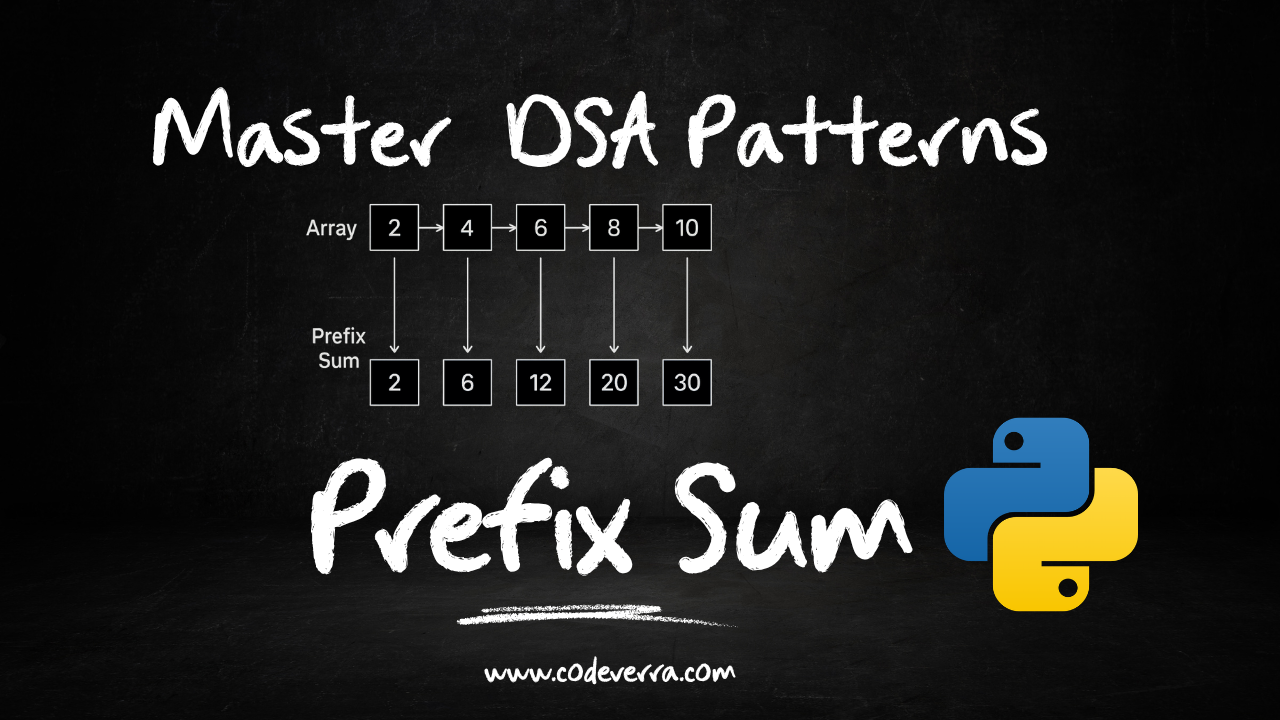
🔰 Pattern 3: Prefix Sum Table of Contents What is Prefix Sum? Building the Intuition Step by Step The Range Sum Formula - Why It Works Common Variations Template Code Problem Set Problem 1: Range Sum Query – Immutable Problem 2: Running Sum of 1D Array Problem 3: Find Pivot Index Problem 4: Subarray Sum Equals K Problem 5: Contiguous Array Problem 6: Product of Array Except Self Problem 7: Subarray Sums Divisible by K Problem 8: Range Sum Query 2D – Immutable Problem 9: Continuous Subarray Sum Problem 10: Count Number of Nice Subarrays Key Takeaways & Summary What is Prefix Sum? Consider this scenario: you have an array of numbers and someone keeps asking you “what’s the sum of elements from index i to index j?” - not once, but hundreds of times with different i and j values. ...
Python Basics Masterclass Variables, Data Types, Strings, Operators, and Input/Output – A Complete Foundation Who is this for? You are new to Python or just getting started. This is the very first thing to read and practice before moving on to collections, loops, functions, or anything else in the curriculum. Every concept is explained simply, with small Indian-context examples, before moving to the next. Table of Contents How Python Works Your First Python Program Comments Variables and Assignment Naming Rules and Conventions Python Keywords Numbers – int, float, complex The math Module Booleans None – The Absence of a Value Strings – Complete Guide Operators Type Conversion Input and Output f-strings and String Formatting Practice Questions Solutions What Comes Next 1. How Python Works When you write Python code and run it, here is what happens behind the scenes: ...
Python Collections Lists, Tuples, Dictionaries, and Sets – The Four Ways to Store Data Before We Begin – Why Collections Are Central to Everything At some point you stop writing programs that work on one value at a time and start writing programs that work on many values at once. A list of students. A dictionary of city populations. A set of unique tags. A tuple representing a coordinate. Collections are the bridge between “I know Python basics” and “I can solve real problems.” Everything that follows in this curriculum – loops, functions, Pandas, APIs – assumes you are comfortable with collections. ...
Python Learning Roadmap The Complete Codeverra Curriculum – Your Navigation Hub This document is the master index for everything published at Codeverra. Every blog, masterclass, and practice workbook links back here. Bookmark this page. Return to it whenever you finish a topic and want to know what is next. How to Use This Roadmap The curriculum is divided into four phases. Each phase builds on the previous one. Do not skip phases. A student who rushes into Pandas without knowing loops and functions will struggle badly. Each topic has a blog (concept explanation), a practice workbook (questions), and a solutions file. The estimated time per phase assumes consistent practice of 1 to 2 hours per day. Phase 1 – Python Foundations Estimated time: 4 to 6 weeks This is where everything starts. Master these before touching any library or framework. Every data scientist, backend engineer, ML engineer, and data engineer uses these concepts every day. ...
🔁 Python Loops Masterclass Complete Command Over for and while Loops — From Basics to Patterns Who is this for? You know Python basics — variables, conditionals, functions. Now you want to truly master loops — not just use them, but think in them. This guide covers every loop concept in Python, with simple examples before every idea. 📌 Table of Contents Why Loops Exist The for Loop Iterating Over Different Data Types The range() Function The while Loop break — Exit the Loop Early continue — Skip to the Next Iteration pass — Do Nothing (Placeholder) else with Loops enumerate() — Loop with an Index zip() — Loop Over Multiple Sequences Nested Loops List Comprehensions Dictionary and Set Comprehensions Loop Patterns Every Programmer Uses Common Loop Mistakes and How to Avoid Them Practice Questions What We Covered + What’s Next 1. Why Loops Exist Imagine you need to print a welcome message for 500 students. Without loops: ...
Python Refresher for DSA Table of Contents What You Will Learn in This Blog Python Built-in Data Types for DSA Lists Dictionaries Sets Tuples The Collections Module deque defaultdict Counter List Comprehensions Important Built-in Functions for DSA Sorting in Python String Operations heapq – The Built-in Min Heap Common Python Patterns in DSA Summary Key Takeaways Next Steps What You Will Learn in This Blog The Python built-in data types you will use constantly in DSA How lists, dictionaries, sets, and tuples work and when to use each Important Python built-in functions and their complexities The collections module – deque, defaultdict, Counter List comprehensions and when to use them Common Python patterns that appear repeatedly in DSA problems This is not a complete Python tutorial. It covers exactly what you need to follow the rest of this guide comfortably. If you are already confident with all of the above, you can skim this and move on. ...